

Unlock the secrets of secure applications with our guide to penetration testing. Mastering application security has never been easier
Understanding Application Security
In today’s interconnected world, application security is paramount. As businesses and individuals increasingly rely on software applications for everything from banking to social media, the potential risks and vulnerabilities have never been greater. Application security involves the measures and practices that organizations implement to protect their software applications from external threats and unauthorized access. This encompasses a range of activities, from secure coding practices to regular vulnerability assessments and penetration testing.

The primary goal of application security is to ensure the confidentiality, integrity, and availability of data. Confidentiality means protecting sensitive information from unauthorized access, integrity involves ensuring that data is accurate and has not been tampered with, and availability means that the application is accessible and functional when needed. Achieving these goals requires a comprehensive approach that includes secure design, secure development practices, rigorous testing, and ongoing monitoring.
One of the most critical aspects of application security is identifying and mitigating vulnerabilities before they can be exploited by malicious actors. This proactive approach helps organizations stay ahead of potential threats and reduces the risk of data breaches and other security incidents. By prioritizing application security, businesses can protect their assets, maintain customer trust, and comply with regulatory requirements.
What is Penetration Testing?
Penetration testing, often referred to as pen testing, is a method used to evaluate the security of an application by simulating an attack from a malicious actor. The objective is to identify vulnerabilities that could be exploited to gain unauthorized access or cause damage. Unlike regular vulnerability assessments, which identify potential weaknesses, penetration testing goes a step further by actively attempting to exploit these vulnerabilities to determine their impact.
Penetration testing can be performed manually by skilled security professionals or through automated tools. Manual testing allows for a more thorough and nuanced examination of an application’s security, as human testers can adapt their strategies and think creatively to uncover hidden vulnerabilities. Automated tools, on the other hand, can quickly scan large applications and identify common security issues. A combination of both methods is often the most effective approach.
There are several types of penetration testing, each with a specific focus. Network penetration testing evaluates the security of an organization’s network infrastructure, while web application penetration testing focuses on identifying vulnerabilities in web-based applications. Mobile application penetration testing examines the security of mobile apps, and social engineering tests assess how susceptible employees are to manipulation and phishing attacks. By conducting penetration tests regularly, organizations can gain a deeper understanding of their security posture and address vulnerabilities before they can be exploited.
The Importance of Penetration Testing in Application Security
Penetration testing plays a crucial role in application security by providing a realistic assessment of an organization’s defenses. Unlike theoretical vulnerability assessments, penetration tests simulate actual attacks, offering insights into how well an application can withstand real-world threats. This practical approach helps organizations identify not only technical vulnerabilities but also weaknesses in processes and human factors.
One of the key benefits of penetration testing is that it helps organizations prioritize their security efforts. By understanding which vulnerabilities pose the greatest risk, businesses can allocate resources more effectively and address the most critical issues first. This targeted approach is essential in today’s fast-paced digital landscape, where new threats emerge constantly and security teams must stay agile to keep up.
Another important aspect of penetration testing is its role in compliance and regulatory requirements. Many industries have specific security standards and regulations that organizations must adhere to, such as the Payment Card Industry Data Security Standard (PCI DSS) for businesses that handle credit card information. Regular penetration testing helps organizations demonstrate compliance with these standards and avoid potential fines and legal repercussions.
Ultimately, penetration testing is about more than just finding and fixing vulnerabilities. It is an ongoing process that helps organizations build a culture of security awareness and resilience. By regularly assessing and improving their security posture, businesses can better protect their assets, maintain customer trust, and stay ahead of evolving threats.
Types of Penetration Testing
Penetration testing comes in various forms, each designed to evaluate different aspects of an organization’s security. Understanding the different types of penetration testing is essential for selecting the right approach to meet specific security needs.
Network Penetration Testing is one of the most common types and focuses on evaluating the security of an organization’s network infrastructure. This includes routers, switches, firewalls, and other network devices, as well as the protocols and services running on the network. The goal is to identify vulnerabilities that could be exploited to gain unauthorized access to the network or disrupt its operations. Network penetration testing is particularly important for organizations with complex and interconnected network environments.
Web application penetration testing is another critical type, as web applications are often the primary target for attackers. This type of testing involves evaluating the security of web applications by identifying vulnerabilities such as SQL injection, cross-site scripting (XSS), and insecure authentication mechanisms. Web application penetration testing helps organizations ensure that their applications are secure and can protect sensitive data from unauthorized access.
Mobile application penetration testing focuses on evaluating the security of mobile apps, which are increasingly being used for a wide range of business and personal activities. This type of testing involves examining the app’s code, data storage, and communication mechanisms to identify vulnerabilities that could be exploited by attackers. Mobile application penetration testing is essential for organizations that develop or use mobile apps, as it helps ensure that these applications are secure and can protect user data.
Social engineering penetration testing assesses the human element of an organization’s security. This type of testing involves simulating attacks that rely on manipulating employees to gain unauthorized access to systems or sensitive information. Common social engineering techniques include phishing emails, pretexting, and baiting. Social engineering penetration testing helps organizations identify weaknesses in their security awareness and training programs and improve their defenses against human-based attacks.
By conducting a combination of these different types of penetration testing, organizations can gain a comprehensive understanding of their security posture and address vulnerabilities across all aspects of their operations.
Which Penetration Test you would want Awantrix solution engineering team can help you select for FREE
The Penetration Testing Process
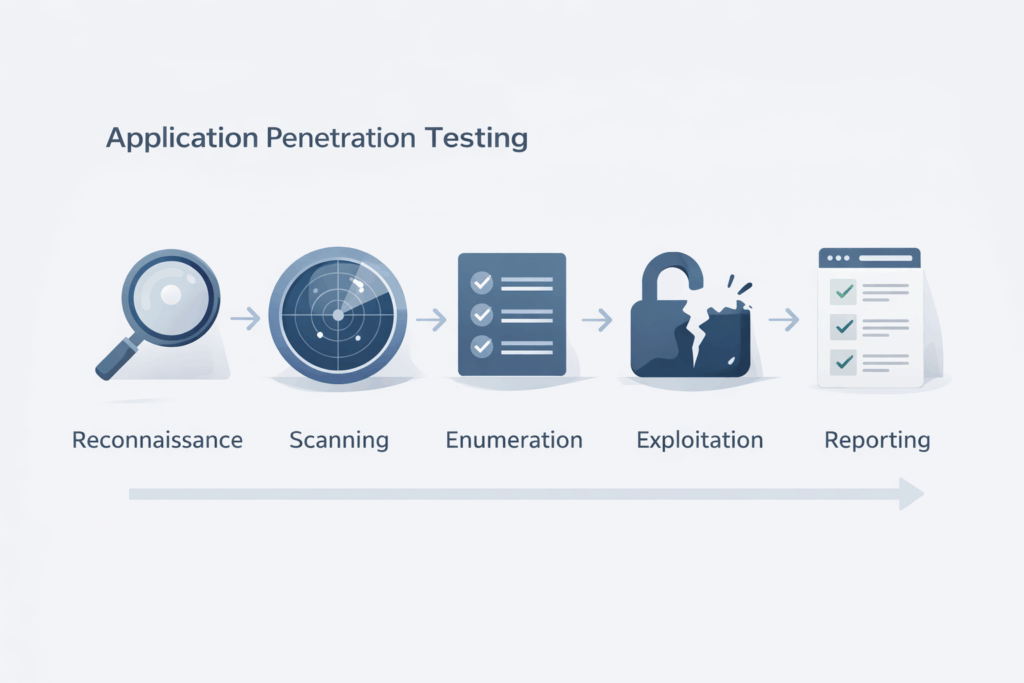
The penetration testing process involves several stages, each designed to provide a thorough evaluation of an application’s security. Understanding these stages is essential for conducting effective penetration tests and obtaining meaningful results.
2. The second stage is scanning and enumeration. In this stage, the testing team uses automated tools to scan the target environment for vulnerabilities. This includes identifying open ports, running services, and potential weaknesses in the system’s configuration. The team also enumerates user accounts, shares, and other resources that could be exploited during the test. The goal of this stage is to create a detailed map of the target environment and identify potential entry points for the attack.
3. The third stage is gaining access. During this stage, the testing team attempts to exploit the identified vulnerabilities to gain unauthorized access to the target systems. This may involve using techniques such as SQL injection, buffer overflow attacks, or password cracking. The team documents each successful exploitation, noting the methods used and the level of access obtained. This stage helps the organization understand how an attacker could move laterally within the environment and access sensitive data.
4. The fourth stage is maintaining access. In this stage, the testing team attempts to establish a persistent presence within the target environment. This may involve creating backdoors, installing rootkits, or using other methods to maintain access even if the initial vulnerability is patched. The goal of this stage is to assess the organization’s ability to detect and respond to ongoing attacks.
5. The final stage is reporting and remediation. During this stage, the testing team compiles a detailed report of their findings, including the vulnerabilities identified, the methods used to exploit them, and the potential impact on the organization. The report also includes recommendations for remediation, such as patching vulnerabilities, improving configurations, and enhancing security policies. The organization uses this information to address the identified issues and improve their overall security posture.
By following a structured and comprehensive penetration testing process, organizations can gain valuable insights into their security weaknesses and take proactive steps to mitigate risks.
Tools and Techniques for Effective Penetration Testing
Effective penetration testing relies on a combination of tools and techniques to identify and exploit vulnerabilities. Understanding these tools and techniques is essential for conducting thorough and successful penetration tests.

One of the most widely used tools for penetration testing is Metasploit. Metasploit is an open-source framework that provides a comprehensive suite of tools for conducting penetration tests. It includes a vast library of exploits, payloads, and auxiliary modules that can be used to identify and exploit vulnerabilities in a wide range of systems and applications. Metasploit also offers features for post-exploitation, such as pivoting and privilege escalation, making it a versatile tool for penetration testers.
Another important tool for penetration testing is Nmap. Nmap, short for Network Mapper, is a powerful network scanning tool that is used to discover hosts and services on a network. It can identify open ports, running services, and potential vulnerabilities, providing valuable information for the reconnaissance and scanning stages of the penetration testing process. Nmap also supports advanced features such as OS detection, version detection, and scriptable interaction with the target environment, making it an essential tool for network penetration testing.
Burp Suite is another popular tool, particularly for web application penetration testing. Burp Suite is an integrated platform that includes a range of tools for testing the security of web applications. It includes features such as a web proxy, scanner, intruder, and repeater, which can be used to identify vulnerabilities such as SQL injection, cross-site scripting (XSS), and insecure authentication mechanisms. Burp Suite also supports custom extensions and scripts, allowing penetration testers to extend its functionality and tailor it to their specific needs.
In addition to these tools, penetration testers also use a variety of techniques to identify and exploit vulnerabilities. One common technique is social engineering, which involves manipulating individuals to gain unauthorized access to systems or information. This may include phishing emails, pretexting, and baiting. Social engineering tests help organizations assess the effectiveness of their security awareness and training programs and identify areas for improvement.
Another technique is fuzzing, which involves sending malformed or unexpected input to an application to identify vulnerabilities such as buffer overflows and input validation errors. Fuzzing can be performed manually or using automated tools, and it is particularly useful for identifying vulnerabilities in software applications and protocols.
By combining a range of tools and techniques, penetration testers can conduct thorough and effective tests that provide valuable insights into an organization’s security posture.
Common Vulnerabilities Identified in Penetration Testing
Penetration testing often reveals a range of common vulnerabilities that can pose significant risks to an organization’s security. Understanding these vulnerabilities is essential for addressing them effectively and improving overall security.
One of the most common vulnerabilities identified in penetration testing is SQL injection. SQL injection occurs when an attacker is able to insert malicious SQL code into a query, allowing them to manipulate the database and access sensitive information. This vulnerability is often the result of improper input validation and can be mitigated by using parameterized queries and prepared statements.
Cross-site scripting (XSS) is another common vulnerability. XSS occurs when an attacker is able to inject malicious scripts into a web application, which are then executed by the user’s browser. This can lead to a range of attacks, such as session hijacking, defacement, and data theft. XSS can be mitigated by implementing proper input validation and output encoding.
Insecure authentication mechanisms are also frequently identified in penetration testing. This includes weak passwords, lack of multi-factor authentication, and improper session management. Insecure authentication mechanisms can allow attackers to gain unauthorized access to systems and data. Mitigating these vulnerabilities involves implementing strong password policies, using multi-factor authentication, and ensuring secure session management practices.
Another common vulnerability is insecure configuration. This includes misconfigured servers, unnecessary services, and default credentials. Insecure configurations can provide attackers with easy access to systems and data. Mitigating these vulnerabilities involves regularly reviewing and hardening system configurations, disabling unnecessary services, and changing default credentials.
Buffer overflows are also commonly identified in penetration testing. Buffer overflows occur when an application writes more data to a buffer than it can hold, causing the data to overflow into adjacent memory. This can allow attackers to execute arbitrary code and gain control of the system. Mitigating buffer overflows involves implementing proper input validation and using secure coding practices to prevent buffer overflows from occurring.
By understanding and addressing these common vulnerabilities, organizations can significantly improve their security posture and reduce the risk of successful attacks.
Best Practices for Conducting Penetration Tests
Conducting effective penetration tests requires following best practices to ensure thorough and meaningful results. These best practices help organizations identify and address vulnerabilities, improve their security posture, and protect their assets.
One of the most important best practices is to define clear objectives and scope for the penetration test. This involves working with stakeholders to identify the systems and applications to be tested, as well as any specific areas of concern. Clearly defining the objectives and scope helps ensure that the penetration test is focused and relevant, and that the results are actionable.
Another best practice is to use a combination of manual and automated testing methods. While automated tools can quickly scan large applications and identify common vulnerabilities, manual testing allows for a more thorough and nuanced examination of an application’s security. Combining both methods provides a comprehensive assessment and helps identify vulnerabilities that may be missed by automated tools alone.
It is also important to conduct penetration tests regularly. Security threats are constantly evolving, and new vulnerabilities are discovered all the time. Regular penetration testing helps organizations stay ahead of potential threats and ensure that their security measures are up to date. This proactive approach is essential for maintaining a strong security posture.
Collaboration and communication are also key best practices. Penetration testing should be a collaborative effort between the testing team and the organization’s stakeholders. This includes regular communication throughout the testing process, as well as a thorough debriefing and review of the findings. Effective collaboration and communication help ensure that the penetration test is aligned with the organization’s goals and that the findings are understood and acted upon.
Finally, it is essential to follow up on the findings of the penetration test. This involves addressing the identified vulnerabilities, implementing the recommended remediation measures, and verifying that the issues have been resolved. Following up on the findings helps ensure that the penetration test has a lasting impact and that the organization’s security posture is improved.
By following these best practices, organizations can conduct effective penetration tests that provide valuable insights and help improve their overall security.
How to Respond to Penetration Testing Findings
Responding effectively to penetration testing findings is crucial for improving an organization’s security posture and mitigating risks. This involves a structured approach to addressing the identified vulnerabilities and implementing the recommended remediation measures.
The first step in responding to penetration testing findings is to prioritize the identified vulnerabilities. Not all vulnerabilities pose the same level of risk, and it is important to focus on addressing the most critical issues first. This involves assessing the potential impact of each vulnerability and determining the likelihood of it being exploited. High-risk vulnerabilities should be addressed immediately, while lower-risk issues can be scheduled for remediation based on their priority.
Once the vulnerabilities have been prioritized, the next step is to develop a remediation plan. This plan should outline the specific actions that need to be taken to address each vulnerability, as well as the timeline for completing these actions. The plan should also assign responsibilities to the appropriate team members and include any necessary resources or support. Developing a clear and detailed remediation plan helps ensure that the vulnerabilities are addressed in a timely and organized manner.
Implementing the remediation measures is the next step. This may involve applying patches, updating configurations, improving security policies, or implementing additional security controls. It is important to follow best practices and guidelines when implementing these measures to ensure that they are effective and do not introduce new vulnerabilities. Regular testing and validation should also be conducted to verify that the remediation measures have been successfully implemented.
“Communication and collaboration are also important when responding to penetration testing findings. This involves keeping stakeholders informed of the progress and any challenges encountered during the remediation process. Regular updates and status reports help ensure that everyone is aligned and that any issues can be addressed promptly. Effective communication and collaboration also help build a culture of security awareness and accountability within the organization”
Finally, it is important to conduct a follow-up assessment to verify that the vulnerabilities have been successfully addressed. This may involve conducting additional penetration tests or vulnerability assessments to ensure that the remediation measures are effective and that no new issues have been introduced. A follow-up assessment helps ensure that the organization’s security posture has been improved and that the risks have been mitigated.
By following a structured approach to responding to penetration testing findings, organizations can effectively address vulnerabilities, improve their security posture, and protect their assets.
Future Trends in Application Security and Penetration Testing
As technology continues to evolve, so too do the threats and challenges in application security. Understanding the future trends in application security and penetration testing is essential for staying ahead of potential risks and ensuring the ongoing protection of assets and data.
One of the key future trends in application security is the increasing use of automation and artificial intelligence (AI). Automation and AI can enhance the effectiveness and efficiency of penetration testing by automating routine tasks, analyzing large volumes of data, and identifying patterns and anomalies that may indicate potential vulnerabilities. These technologies can also help organizations respond more quickly to emerging threats and improve their overall security posture.
Another important trend is the shift towards a more proactive approach to security. Traditionally, security has been reactive, with organizations focusing on responding to incidents and patching vulnerabilities after they have been identified. However, there is a growing emphasis on proactive security measures, such as threat hunting, continuous monitoring, and real-time threat intelligence. This proactive approach helps organizations identify and address potential threats before they can be exploited, reducing the risk of successful attacks.
The increasing adoption of cloud computing and the rise of containerization and microservices are also shaping the future of application security. These technologies offer significant benefits in terms of scalability, flexibility, and efficiency, but they also introduce new security challenges. Organizations must ensure that their cloud environments and containerized applications are secure by implementing best practices such as secure configurations, identity and access management, and continuous monitoring.
The growing importance of privacy and data protection is another key trend in application security. With the introduction of regulations such as the General Data Protection Regulation (GDPR) and the California Consumer Privacy Act (CCPA), organizations are under increasing pressure to protect personal data and ensure compliance with privacy laws. This involves implementing robust data protection measures, conducting regular privacy assessments, and ensuring that security practices align with regulatory requirements.
Finally, the human element of security continues to be a critical factor. Social engineering attacks, such as phishing and pretexting, remain a significant threat, and organizations must prioritize security awareness and training programs to educate employees about these risks. Building a culture of security awareness and accountability is essential for protecting against human-based attacks and ensuring the overall security of the organization.
By staying informed of these future trends and adapting their security strategies accordingly, organizations can stay ahead of potential threats and ensure the ongoing protection of their assets and data.